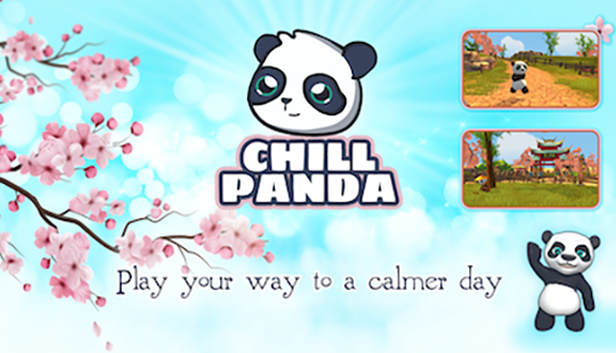
Chill Panda teaches children simple techniques for recognising and managing anxiety. When signs of anxiety are detected, users are prompted to complete wellbeing activities based on movement, distraction, or breathing exercises, which Dr Micklewright says are “well-used strategies for helping children manage worry or anxiety.”
We are continuing to develop the app, and have recently been working on a feature where users can measure their heart rate, then use a sliding scale to indicate how they are feeling, and the app will place them on a ‘mood grid’ and enable them to easily track their progress.
18th January, Blue Monday, is supposedly the most depressing day of the year. The riot of Christmas decorations has gone, your bank account is jaded, and dark evenings begin shortly after breakfast.
You’d be forgiven for thinking the whole of 2020 was a Blue Monday and 2021’s not been much fun so far. The third lockdown began as we pulled the last cracker, Covid19 infections continue to rise and many struggle to teach their children, stave off loneliness, and pay their bills.
Lockdowns have highlighted how these struggles are most keenly felt where there are societal inequalities. We’ve seen the digital divide impact negatively on home-schooling; when families don’t own laptops or have affordable, reliable internet it’s very hard to home school.
But technology can help children feel less anxious – if provision is equal to all. Liverpool 5G Create, a health, social care and education project based in and around Kensington, Liverpool, (funded by the Government’s Department for Digital, Culture, Media, and Sport) has worked hard to reduce the digital divide in Liverpool. The team created an independent 5G network, using UK-designed hardware, that supports health, social care, and education technologies for people taking part in the project.
The technologies trialed during the project included Push-to-Talk, which connects people feeling isolated for a cost-free chat, sensors that detect when an older person falls and needs help, and a bingo and gaming app used by residents at a care home.
In spring 2021 Liverpool games studio, CGA Studios, will bring Chill Panda to the project helping children feeling anxious/isolated learn to manage their feelings and learn new coping strategies.
Originally designed by the games studio as a mobile app, the game for children under eight was launched on Nintendo Switch before Christmas. Chill Panda lives on his beautiful, blossom-filled island, riding around on his scooter, meeting friends like Wise Panda and Sporty Panda, making sandcastles, building and farming.
Panda helps children recognise and manage feelings of anxiety, whilst playing the game, by teaching them breathing exercises, yoga, and distraction puzzles and activities. Surveys and parent/teacher interviews will be used to measure improvement in two key areas: knowledge and understanding of anxiety. CGA expects children to show a 10 – 15% improvement in both.
The game was co-created with child psychologist, Dr. Caroline Belcher, also a director of the games company, who says: “After working with anxious children in my job I noticed there were lots of games/apps aimed at anxious adults but nothing similar for children.
“Children nowadays relate to and learn well through gaming. Exciting games like Chill Panda enable children to learn coping mechanisms whilst having fun. Families can play the game together so that parents learn more about how their children are feeling in a non-pressurised way.”
For the Liverpool 5G Create project, Chill Panda will be linked to wearable devices enabling children at schools in Liverpool to learn how anxiety affects their heart rate and how to manage this.
The Liverpool 5G network is provided free to the communities using the wearables, which means all the children at participating schools can take part – whether they have reliable home wifi or not. The low latency nature of the 5G technology means any data or downloads needed for the app will be properly and speedily supported, whilst AI-driven recommendations in the app need 5G technology to work.
Wilfie, aged six, had this to say about playing the game: “I enjoy playing Chill Panda because it’s fun but it also makes me feel calm. Feeling calmer makes me feel happy.”
Hopefully 2021 will turn out to be slightly less stressful for children than 2020 and ‘technology for good’ will have a role to play in making that a reality.
In the noughties Merlins and Hermiones from leafy London suburbs started practising yoga at primary school – another obscure hobby to add to an exotic list of after-school pursuits like free jazz and felting.
It is easy to see how adults benefit – an hour of peace, contemplation and relaxation for busy Mums, stressed executives or a frazzled students. Yoga’s physical and mental health benefits are well documented but what does a preschooler have to worry about? Surely the fun of being five is that you can go at life full pelt and hang the consequences?
There’s increasing research to highlight yoga’s benefits to children. One study – Perceived Benefits of Yoga among Urban School Students: A Qualitative Analysis, Wang and Haginshttps://www.hindawi.com/journals/ecam/2016/8725654/abs/) found yoga helped children ‘relax and reduce stress’ during a school day consisting of ‘loud people, stressful situations, and constant moving’ giving them ‘some mental space for themselves’ to ‘feel relaxed throughout the school day and…their lives outside of school’.
Dr Caroline Wetherall, a Liverpool-based clinical psychologist, co-created NHS recommended anxiety reduction app, Chill Panda, with games producers Onteca. She agrees yoga techniques can help teach children anxiety management: “Working as a clinical psychologist, I’d recognised that whilst there are tools for measuring and managing anxiety in adults, there is nothing comparable for younger children. Digital tools like Chill Panda have a positive role to play in the development of better anxiety prevention and early diagnosis tools for children.”
Whilst developing the app children used storytelling, drawing and discussion at workshops. They explored how animals and humans react to stress and anxiety and talked about the effects of anxiety on our bodies, learning to recognise how their bodies felt when anxious and when relaxed.
Chill Panda features a chilled out panda and his wise friend. Children can play games featuring the panda, monitor their own heart rate and learn simple breathing/ relaxation exercises and yoga poses – panda yoga or ‘Poga’. Focusing on our bodies, self, recognising changes/feelings and learning to process them/move on is a core element of yoga. Surely the younger you learn these techniques the more likely you are to carry them into adult life?
Hannah, a qualified yoga teacher working on Chill Panda’s Poga, agrees: “I became involved with Chill Panda to help with the theoretical development and exploration of yoga in the app. The aim of the ‘Poga’ segment is to positively engage children in the practice of yoga, focusing on breathing, maintaining concentration and stillness. Through gentle sequences of asanas – or poses – tension is released in the physical body allowing children to focus on their breath and relax their minds.’